

Choosing the right visa before setting up in Indonesia is one of the most consequential decisions you will make as an expat or investor. Get it right and everything flows smoothly from tax registration to banking, property ownership, and even sponsoring your family. Get it wrong and you can face work permit violations, KITAS renewal blocks, and significant fines.
If you are planning to launch a business in SCBD, take up a corporate role in Sudirman, or run a villa operation in Bali, you have likely already asked: should I apply for an Investor KITAS or a Work KITAS? This guide gives you a clear, up-to-date answer for 2026. For a broader overview of relocation support in Jakarta and Bali, Noble Asia can also guide you through the full settlement process.
What Is a KITAS and Why Does the Type Matter?
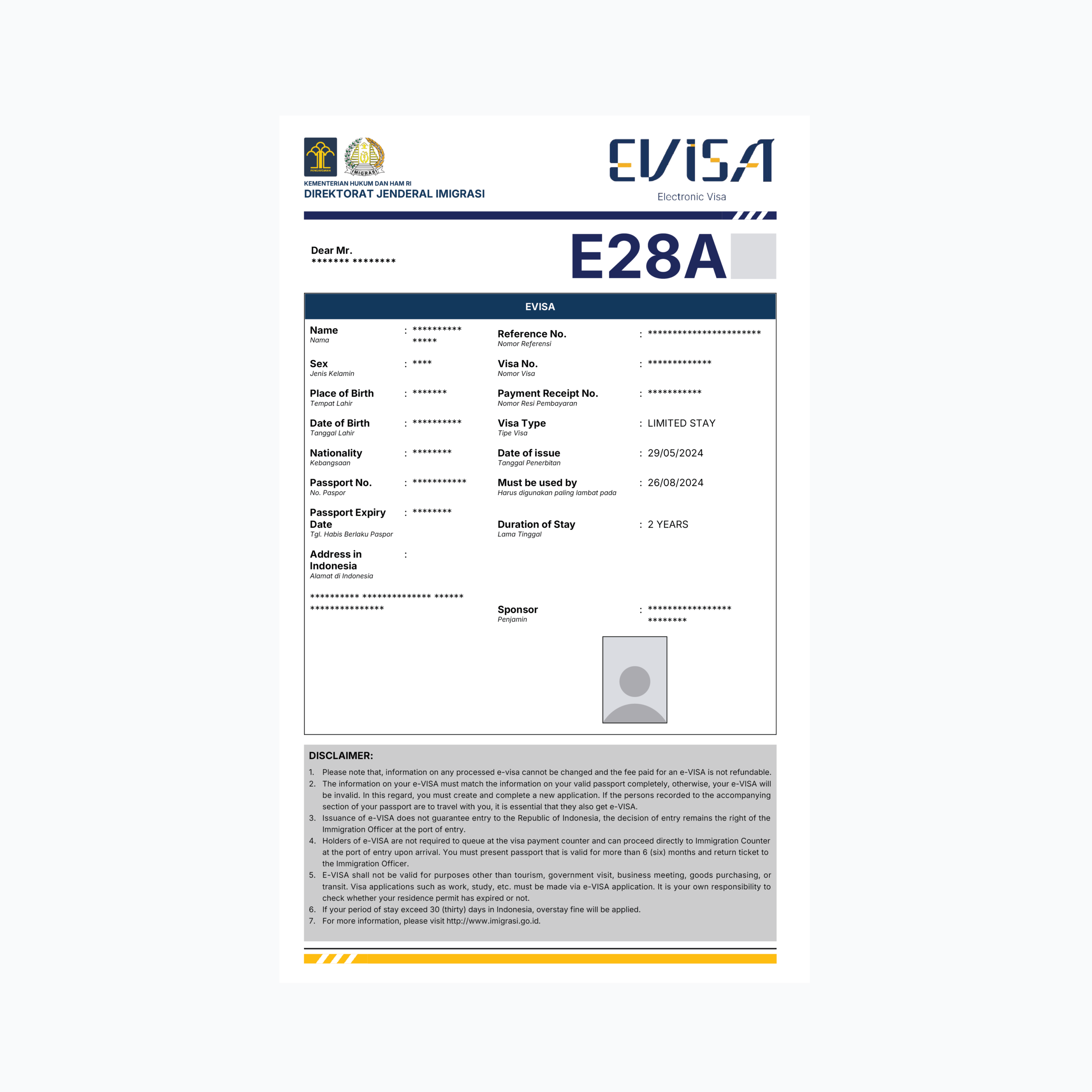
A KITAS (Kartu Izin Tinggal Terbatas) is Indonesia’s limited stay permit for foreign nationals. It is the document that lets you live legally in the country for extended periods. Both investor and work paths result in a KITAS, but the structure, obligations, costs, and long-term options attached to each are meaningfully different.
Think of the visa type as the foundation of your entire Indonesian life. It determines where your income can come from, what you can and cannot do professionally, how much you pay in fees and taxes, and how quickly you can qualify for permanent residency down the road.
What Is a Work KITAS?
A Work KITAS (indexed E23) is issued to foreign nationals who are formally employed by an Indonesian-registered company. The employer sponsors the permit, and the visa is tied to a specific job role and company. It is the standard path for professionals joining multinational firms in Sudirman, SCBD, consulting firms in Central Jakarta, and corporate operations across Indonesia.
Work KITAS Requirements
- A legally registered Indonesian company as sponsor (PT, PT PMA, Representative Office, or Foundation)
- RPTKA (Foreign Worker Utilization Plan) approval from the Ministry of Manpower
- IMTA (work permit / Izin Menggunakan Tenaga Kerja Asing) issued for your specific role
- Employment contract with the sponsoring company
- Relevant qualifications and professional experience matching the approved role
- Valid passport with at least 6 months validity (18 months recommended)
An important 2026 update: Work KITAS is now also available to directors and commissioners of PT PMA companies whose capital falls below the IDR 10 billion threshold required for an Investor KITAS. This means startup founders and early-stage entrepreneurs with a smaller capital base can still legally reside and operate in Indonesia through a Work KITAS sponsored by their own PT PMA.
Benefits of a Work KITAS
- Full legal right to work in Indonesia for the sponsoring employer
- Eligibility for local salary and payroll processing
- Mandatory access to BPJS Kesehatan and BPJamsostek after 6 months of residency
- Streamlined NPWP (tax number) registration via payroll withholding
- Ability to sponsor spouse and children through Dependent KITAS
Limitations of a Work KITAS
- You can only work for the specific sponsoring company and in the specific approved role
- Changing employers requires cancelling the existing KITAS and starting a new application from scratch
- The IMTA (work permit) is only issued for 1 year maximum, which means a Work KITAS cannot exceed 1 year validity despite the immigration system technically allowing 2 years
- DKP-TKA fees apply (a compensation fund levy for employing foreign workers)
- Strict reporting obligations to both the immigration office and the Ministry of Manpower
What Is an Investor KITAS?
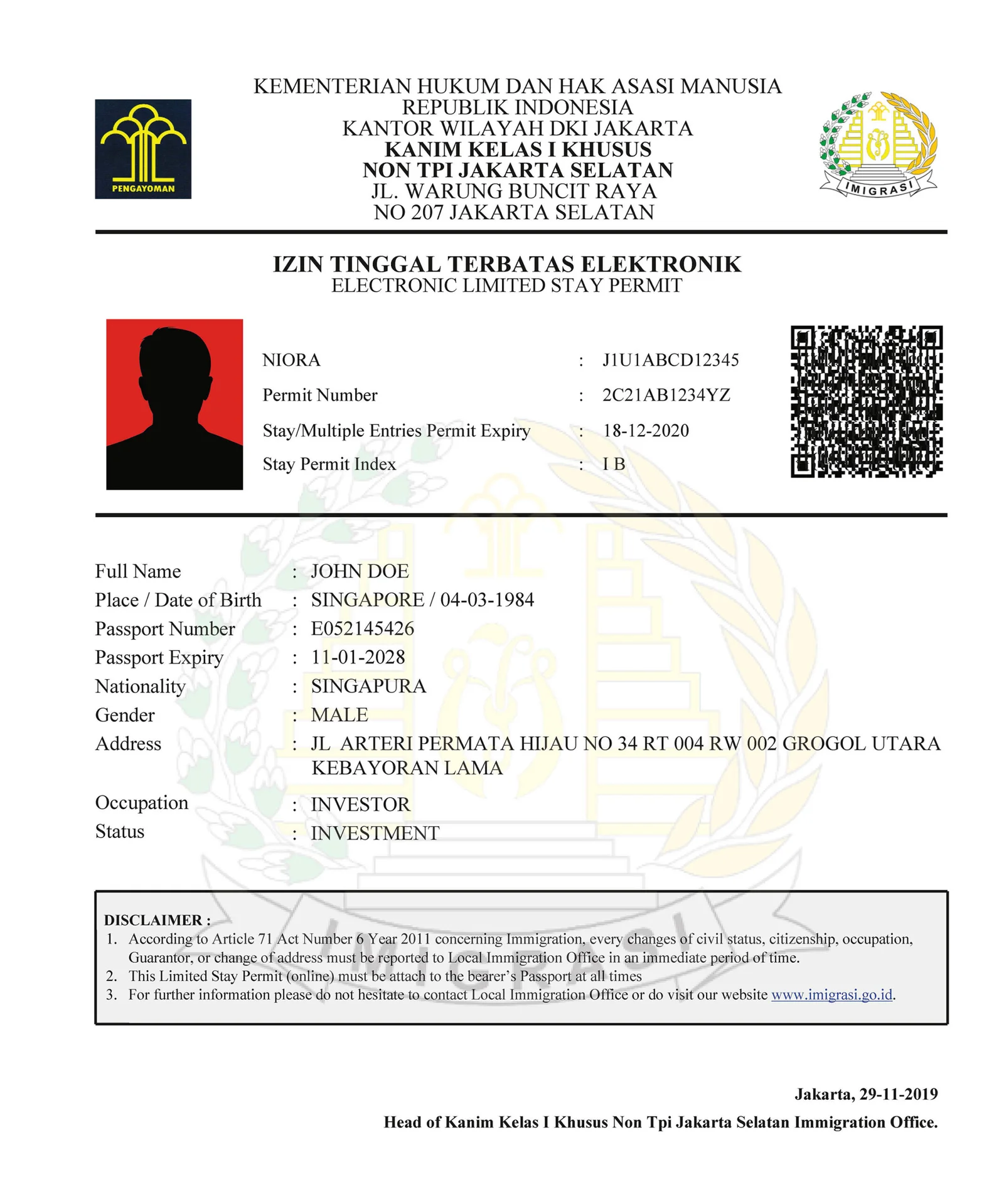
An Investor KITAS is designed for foreign nationals who hold shares in a PT PMA (Perseroan Terbatas Penanaman Modal Asing, or foreign-owned limited liability company) and meet the required capital threshold. It is commonly used by startup founders, company directors and commissioners, property investors, and business owners operating in Jakarta and Bali.
A critical distinction: the Investor KITAS is primarily a residency permit, not a work authorization. It allows you to manage your company at a strategic level, sign documents, oversee operations, and hire and direct employees. It does not automatically authorize you to perform the operational or technical work that your employees do. For that, you need to be formally registered as a director or commissioner in the company deed.
Investor KITAS Requirements (2026 Update)
The regulatory picture for Investor KITAS has shifted significantly in late 2024 and 2025. Here is the current framework under BKPM Regulation No. 5 of 2025 and Minister of Law and Human Rights Regulation No. 3 of 2025:
- Shareholding in a PT PMA as a registered director or commissioner
- Minimum personal investment of IDR 10 billion per shareholder to qualify for Investor KITAS (this threshold has not changed despite the paid-up capital reduction)
- Minimum paid-up capital of IDR 2.5 billion per PT PMA (reduced from IDR 10 billion under BKPM Regulation No. 5/2025, effective October 2025)
- Company deed and approvals from the relevant ministries and the OSS (Online Single Submission) system
- Valid passport and domicile documentation
- For Investor KITAP (permanent stay): minimum investment of IDR 15 billion per shareholder and a minimum of 4 years holding an Investor KITAS
This is an important nuance that trips up many investors: the paid-up capital for setting up a PT PMA has dropped to IDR 2.5 billion, but the personal investment threshold to qualify for an Investor KITAS remains IDR 10 billion. You can establish the company with less capital, but you need IDR 10 billion in personal shareholding to get the KITAS.
Additionally, PT PMA compliance inspections have intensified in 2025, particularly in Bali. Companies with zero LKPM (investment activity report) submissions or disconnected shareholders are being flagged and face potential KITAS renewal denial.
Benefits of an Investor KITAS
- No IMTA work permit required for director-level roles, reducing both cost and administrative burden
- No DKP-TKA compensation fund levy, unlike Work KITAS holders
- Validity of 1 or 2 years, renewable
- Multiple-entry rights allowing you to travel in and out of Indonesia freely
- Ability to sponsor spouse and children through Dependent KITAS
- More flexibility in managing your own business as a shareholder-director
- Clear path to Investor KITAP (5-year permanent stay) after 4 years
Limitations of an Investor KITAS
- Requires real capital commitment at IDR 10 billion minimum per shareholder
- Does not authorize work for any other company outside your own PT PMA
- Subject to corporate reporting obligations including quarterly LKPM filings. Failure to report can now result in business license suspension under 2025 BKPM regulations
- PT PMA inspections are increasing, especially in Bali. Companies that do not reflect genuine business activity face KITAS renewal problems
Key Differences: Investor KITAS vs Work KITAS
Here is a side-by-side comparison of the two visa types across the most important dimensions:
| Feature | Work KITAS | Investor KITAS |
| Sponsor | Employer / Indonesian company | Your own PT PMA |
| Work Permit (IMTA) | Required | Not required (most director roles) |
| Investment Required | No | IDR 10 billion minimum |
| DKP-TKA Fee | Yes | No |
| Suitable For | Employees & corporate hires | Business owners & investors |
| Validity | 1 year (max, due to IMTA limit) | 1 or 2 years |
| Salary / Income | Yes, via payroll | Yes, via dividends or director fee |
| KITAP Eligibility | Yes, after 3 years | Yes, after 4 years + IDR 15B |
Can You Combine Investor Status and Employment?
This is one of the most common questions we get from entrepreneurs and executives. The short answer is: it depends on how your roles are structured, and you cannot simply double up without proper legal planning.
- If you are a shareholder-director of your PT PMA with IDR 10 billion in investment: an Investor KITAS is sufficient to manage and oversee your company.
- If you also want to work for a completely separate Indonesian company: you need a distinct Work KITAS sponsored by that employer. The two cannot be merged under one permit.
- If your PT PMA capital falls below IDR 10 billion: you can apply for a Work KITAS sponsored by your own PT PMA for the director or specialist role instead.
Working outside your permitted scope is one of the most common immigration violations in Indonesia, and enforcement has tightened noticeably in 2025. Proper visa structuring should be part of your business setup from day one, not an afterthought.
Which Visa Is Better for Property Investors in Jakarta or Bali?
If your primary goal is owning and operating investment property in Indonesia, whether that is commercial property in SCBD, rental apartments in Sudirman, or villas in Bali’s growing market in Canggu or Seminyak, the Investor KITAS is generally the more appropriate path.
Here is why: property investment in Indonesia requires a PT PMA structure for foreigners to legally own and rent out property. Once your PT PMA is established, the Investor KITAS gives you the residency and management rights to oversee that investment without requiring a separate work permit. The KITAP pathway that opens after 4 years also allows you to own property under Hak Pakai (Right to Use) schemes, maintain Indonesian bank accounts, and re-enter freely.
However, if you are primarily a salaried professional working for a corporation in Jakarta and not running your own PT PMA, the Work KITAS is the correct and only legal route. Trying to use an Investor KITAS in a purely employee context is not compliant and creates risk at renewal.
Tax Implications: Investor vs Work KITAS
Both Investor and Work KITAS holders must register for an NPWP (tax number) once they have their NIK from civil registration. Both are subject to Indonesian income tax if they qualify as tax residents (more than 183 days in a tax year).
The key difference lies in how income is structured:
- Work KITAS holders receive salary through payroll, with income tax withheld automatically by the employer each month under the Article 21 withholding regime.
- Investor KITAS holders typically structure income through dividends or director compensation fees, which may offer more flexibility in tax planning but require proper corporate structuring and reporting.
Since July 2024, NIK and NPWP have been integrated for Indonesian citizens, and the new Coretax system at pajak.go.id links banking and tax records more directly than ever. Both Work and Investor KITAS holders are increasingly subject to cross-referenced compliance. Professional tax advisory is strongly recommended, especially for high-value investments in Central Jakarta or Bali.
For a full breakdown of how NIK ties into tax registration and banking for foreigners, read our guide on NIK for foreigners: tax, BPJS, and banking in Indonesia.
Renewal Cycles and the Path to KITAP
Both Work and Investor KITAS are renewable, and both can lead to a KITAP (permanent stay permit) with different timelines:
- Work KITAS: renewed annually (limited by IMTA validity). KITAP eligibility begins after 3 consecutive years with the same sponsor.
- Investor KITAS: valid for 1 or 2 years. KITAP eligibility for investors begins after 4 years of continuous Investor KITAS, with a minimum investment of IDR 15 billion per shareholder. The Investor KITAP is valid for 5 years and is extendable indefinitely.
Key renewal requirement for both: your registered domicile address must be current and reflect your actual place of residence. If you have moved between neighborhoods or cities, update your address through the RT/RW Lapor Diri process before submitting your renewal. Read our guide on how to complete Lapor Diri when moving in Jakarta or Bali to avoid delays.
For Investor KITAS holders in Bali specifically, 2026 has brought significantly stricter LKPM reporting enforcement. PT PMA companies must submit quarterly investment activity reports to BKPM. Companies with zero reports or inactive filing histories are now being flagged for inspections, and KITAS renewals for those companies’ shareholders are being blocked.
Common Mistakes to Avoid
- Assuming an Investor KITAS allows you to work for any company. It only covers your role within your own PT PMA.
- Underestimating the capital requirements. The paid-up capital for a PT PMA is now IDR 2.5 billion, but the personal investment requirement for an Investor KITAS remains IDR 10 billion.
- Registering a PT PMA with minimal genuine business activity. In 2025, compliance inspections are targeting dormant or zero-reporting companies, especially in Bali.
- Not aligning tax planning with your visa structure from the start. Income structuring decisions made at setup have long-term implications.
- Letting KITAS expire before renewal. Begin the renewal process at least 60 days before expiry.
- Changing your role within your company, for example moving from commissioner to director, without updating your immigration records. Any role change must be formally reflected in both the company deed and your immigration file.
- Choosing a visa type based on cost alone without considering your actual professional activities and what is legally permissible under each.
How Noble Asia Supports Choosing the Right Visa Pathway
The choice between an Investor KITAS and a Work KITAS is not just an immigration decision. It is a business strategy decision that affects your tax structure, income options, corporate obligations, and long-term residency path in Indonesia.
In 2025, with tightened compliance checks, stricter LKPM reporting, and the new IDR 2.5 billion vs. IDR 10 billion capital paradox for PT PMA, getting expert guidance before you commit to a structure is more important than ever.
Relocating to Jakarta or Bali as an investor or executive involves immigration, property strategy, and tax structuring all at once. At Noble Asia, we provide end-to-end support across relocation planning, visa and immigration coordination, property acquisition in SCBD, Sudirman, Thamrin, and Kemang, and villa management in Bali. We align your visa structure with your business and investment goals so that nothing falls through the cracks.
Planning to invest or work in Indonesia? Let Noble Asia help you choose the right visa pathway while securing the right property and business structure.
Speak with our advisory team today
FAQ: Investor Visa vs Work Visa in Indonesia
Q: What is the core difference between Investor KITAS and Work KITAS?
Work KITAS is for employees sponsored by an Indonesian employer. It requires an IMTA work permit and ties you to a specific company and role. Investor KITAS is for shareholders of a PT PMA with IDR 10 billion in personal investment. It does not require an IMTA but is limited to overseeing your own company.
Q: Do I need a work permit if I have an Investor KITAS?
In most cases, no. Director and commissioner level Investor KITAS holders do not require a separate IMTA work permit. However, if you are performing the operational work of an employee rather than a director, a Work KITAS with IMTA is more appropriate.
Q: Can I switch from Work KITAS to Investor KITAS?
Yes, if you establish or invest in a qualifying PT PMA with at least IDR 10 billion in personal shareholding. The switch requires a formal immigration process and cannot be done mid-permit without proper cancellation and new application procedures.
Q: Which visa is better for startup founders in Jakarta?
It depends on your capital. If you have IDR 10 billion in your PT PMA, Investor KITAS is typically more cost-efficient and flexible. If your capital is below that threshold, directors and commissioners can now use a Work KITAS sponsored by their own PT PMA under the 2023 to 2025 regulatory updates.
Q: Can Investor KITAS holders receive a salary?
Yes, as company directors or commissioners, depending on your corporate structure. Income may be structured as a director compensation fee. Dividend distributions are also possible but carry specific tax reporting requirements.
Q: Is Investor KITAS cheaper than Work KITAS?
Generally yes. Investor KITAS holders do not pay the DKP-TKA compensation fund levy required for Work KITAS holders. Government fees are also typically lower. However, the capital investment requirement is substantially higher.
Q: Can I buy property in Indonesia with an Investor KITAS?
Foreigners can own property through their PT PMA under certain ownership structures, or personally under Hak Pakai (Right to Use) once they hold KITAP status. An Investor KITAS on its own does not grant direct personal property ownership rights, but it is the first step toward KITAP which does.
Q: How long does processing take?
Typically 3 to 8 weeks depending on the completeness of your corporate documentation and immigration office workload. Offshore VITAS processing before entry can take 5 to 10 business days when documents are in order.
Q: Can I sponsor my family under an Investor KITAS?
Yes. Spouse and children can obtain Dependent KITAS under your Investor KITAS sponsorship. Since December 2025, E33G Digital Nomad KITAS holders can also sponsor family Dependent KITAS. For a full breakdown, read our guide on spouse and dependent KITAS for expat families.
Q: Are visa rules different in Bali compared to Jakarta?
The core visa regulations are national and apply across Indonesia. However, business licensing, regional compliance inspections by BKPM, and local immigration office practices can vary. Bali in particular has seen a surge in PT PMA compliance checks in 2025, making clean corporate governance especially important for Bali-based Investor KITAS holders.